Reprinted with permission from the American Quilt Study
Group.
https://americanquiltstudygroup.org
By Marsha MacDowell, Mary Worrall, Beth Donaldson, Dean
Rehberger, and Alicia Sheill
In
2003, after several
years of planning and testing, the Quilt Index (www.quiltindex.org) was launched with
quilt-related data drawn from collections at just four
institutions - Michigan State
University Museum, Illinois State Museum,
Tennessee State Library
and Archives, and the University of Louisville Archives and
Records Center.
For the first time, quilt-related data from
geographically spread institutions were freely accessible to anyone in the world with access to the Internet and were searchable across collections. As of August 2016, there are
now more than 80,000 quilts drawn from collections from hundreds of museums,
numerous documentation projects, and many private collections from around the world.
Meeting Goals and
Charting New Directions
While the Index always aimed to be the central
international repository for images, information, ephemera, and stories about quilts and their makers, one of the original goals was to provide a
centralized digital repository to preserve and make accessible the
records of the U.S. quilt documentation projects of the
last quarter of the twentieth century. Slowly, but surely,
that goal is being achieved.
Already all of the records of historical
documentation projects in Connecticut, Florida, Hawaii, Indiana, Iowa, Kansas, Kentucky, Louisiana,
Massachusetts, Michigan, Minnesota, Nebraska, New Jersey, North Carolina, Rhode Island, Tennessee,
Texas, and Wyoming, as well as some of the records of historical projects in Hawaii,
Illinois, and Kansas, are available through the Index.1 The QI team is working with the American Folk Art Museum to soon add the records of the New York Quilt Project. In addition
to
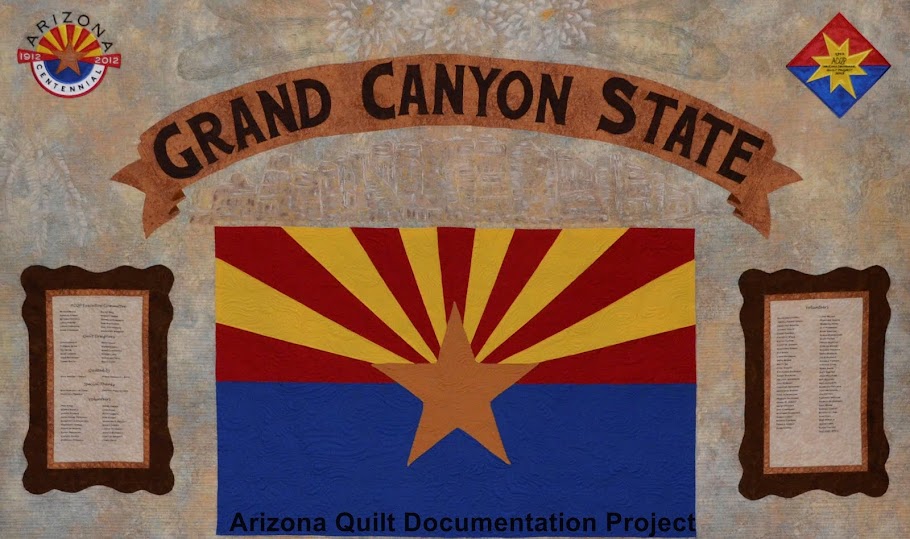
these historical projects, new and ongoing projects in Arizona,
Oregon, South Carolina, Western Pennsylvania, West Virginia, Wisconsin, and Washington are adding their records to the QI.
An early new direction for the QI was to
internationalize the content and adaptations for easy inclusion included addressing
language restrictions, locale fields, and other elements and developing new
partnerships with individuals and institutions around the world. As a result,
the QI already contains the
records of historical documentation projects in South
Africa and Canada.
Another direction that was developed early in the history of the QI was to include the records of quilts held in museum
collections. State documentation projects often included museum collections and more than 250 museum
collections are represented as part of state projects.
Strategic work by the QI team has resulted in the inclusion of other museum and archival
collections including those of the American Folklife Center at the Library of Congress, Illinois State Museum, White Bluffs Quilt Museum, Country
Heritage Park, Daughters of the American Revolution Museum, New England Quilt Museum,
Mountain Heritage Center, National Quilt Museum, Rocky Mountain Quilt
Museum, Royal Alberta Museum, and the Briscoe Center for American History at the University of Texas. With support from the Robert and Ardis James
Foundation, the collections of the International Quilt Study Center and Museum are currently being added.
In the last decade the QI team has worked hard to add tools to the Index that
make it easier for data to be entered and for data to be used. Over the last two years we have been working on a visual
overhaul of the website
that will make QI a more
user-friendly and mobile-friendly up-to-date responsive design.
Since the 2003 launch, the
QI was structured around a
focus on the object – the
quilt – but the new iteration of QI will show equally
that this is a repository
on artists, collections, and stories.
Substantial back end programming is developing the
capacity for presenting stories (text, oral, video), creating new search tools, and enabling the ability to
associate QI data – on quilts,
oral histories, stories, photographs, and ephemera - that will greatly
enhance research possibilities.
A Platform for Research
During the past few years, the Index has become a platform
to support new lines of scholarly
inquiry. For instance,
QI staff and an international consortium
of humanities specialists and computer scientists used the Index to test new digital
methods for
visual searching and pattern recognition. Algorithms were developed
to isolate salient characteristics (such as color, or
line/pattern shapes) to sort
through the massive
numbers of quilt images
as a means to investigate
important scientific and humanistic questions.
A pilot Signature Quilt Project allowed testing of training strategies for individuals
involved in shared research interests to individually
submit quilts. A Quilt and Health project is using the Index to build
content about quilts related to health and wellbeing
and then expects to
use information in health education and advocacy.
One researcher approached us about using the Index to store her dissertation
research data on quilts as she collects it. Not only would this ensure
preservation of her data but it would also give
her the immediate advantage of using all of the Index tools and comparing her data with thousands of other quilts.
A project funded by the National Endowment for the Humanities has enabled
us to work with the NAMES
Foundation to input all of
the panels from the AIDS Memorial Quilt. A consortium of digital humanists,
medical educators, and health providers
is investigating strategies for
individuals to add stories, images, and other data that will augment
the now slim data
available on each
panel, as well
as use this quilt in health
education. Public access to the panels
in the QI is
anticipated to occur
in early 2017.
With support from the Salser Family
Foundation, a Detroit News Quilt History Project
is
digitizing,
uploading and transcribing the archives of the Quilt Club Corner of the Detroit News in the 1930s. This is a treasure trove of
stories, patterns, and photographs of
the largest, most successful, newspaper club of the era.
New Projects On The
Horizon
Other new initiatives are under construction
with planned debuts in late 2017 and early 2018 immediately following the launch of the new iteration of QI. With funding from the Sunshine State Quilt
Association, a QI Guild
Project is being
developed and will result
in a means for guilds to present
their histories, show current activities, and upload
their members’ quilts directly into
the Index, thus digitally
preserving guild members’ quilts and their stories while being able to compare their work with the thousands of quilts and
stories in the Index.
The QI Quilt Legacy Project, funded by the family of the late Claire
Vlasin, will result in a strategy for the collections and stories of individual
quilt collectors and/or quilt artists to be preserved permanently in the Index
– even if their collections have been or will be dispersed. It is anticipated
that this will provide a wonderful mechanism to preserve quilt history.
Last, and perhaps most important, with funding from the Robert and Ardis James Foundation, QI is
working on the capacity for individual
quiltmakers and/or owners to upload their quilt images and
stories directly into the Index.
When this feature becomes activated, it is anticipated that the number of 
 quilts,
stories, and artists represented in the Index will grow significantly.
quilts,
stories, and artists represented in the Index will grow significantly.
quilts,
stories, and artists represented in the Index will grow significantly.
Quilt Index and
Future Directions
QI continues to reach out to individuals and
institutions associated with both historical and newly emerging documentation projects to develop mutual
strategies to add their data and QI encourages individuals associated with documentation
projects and collections to contact QI about joining the Index.
QI is committed to constantly keeping current with new technologies. It wants to make the Index work better for those who contribute
information to it as well as those who use it. It wants to use social media and other strategies to spread the word about
the QI and to engage individuals in contributing to and using this amazing resource. It wants to tap crowdsourcing of knowledge to improve and enhance
existing data.
The hope is that the Index can be a place
where ephemeral exhibitions can be seen virtually
forever, where images
and data from auction sales
can be preserved, and where links can be made to key
published resources. Of course, the hope also remains
that all of the records from
the quilt documentation projects in the
U.S. and around the world will be inputted and that the
Index will be able to
provide access to all
quilt collections, be they
held by museums, private individuals, or corporations.
Realities and Dreams
Michigan State University is the institutional home of the Index with Michigan State University
Museum at the helm for overall administration and the intellectual growth of the Index content and MSU’s MATRIX, Center for Digital
Humanities and Social Sciences as the leader in technological innovation.
MSU provides limited baseline project management and technical
assistance, data storage and back-up, continuous updating for all browsers and devices,
innovative programmers, and a
commitment to keeping the Index viable
in perpetuity. The project relies heavily on grants,
contracts, and contributions to increase
content and provide new
tools. Endowments are being cultivated to ensure that the Quilt Index
will continue to grow in content, be able to respond to new user needs, and continually
incorporate the newest technology.
The QI looks to all those who are passionate about making, using, and studying quilts
to
help
it
ensure
that
the Index continues to serve this community as well as continue finding ways to convey to the non- quilt world why quilts and quiltmaking are so special.
One final note: because quilt artists around the world continue to create new work, there will always be new images and stories that need to be added to the Quilt Index.


