Arizona Quilt Documentation Project

Welcome to the Arizona Quilt Documentation Project blog! We are glad you found us. We are passionate about documenting quilts in Arizona. Every quilt is important. Please contact us at azquiltdoc@yahoo.com if you are interested in having your quilts documented. We are happy to help you in any way we can.

Sunday, May 13, 2018

Arizona Quilt Documentation Project – Tucson


By Sue Franklin

Sue began the session by thanking Kate for being photographer as Peggy is in New England with the Migrant Quilt Project.  She also mentioned meeting Dr. James Burns, new Arizona Historical Society Executive Director, in Mid-April at the Arizona History Museum.  Laraine invited her to come to help emphasize the importance of quilts in the Museum collection.  Sue also introduced the Arizona Quilt Documentation Project to Dr. Burns and noted that the Tucson team had documented all but a few of the Museum’s 100+ quilts.  She mentioned other quilts the team has documented, such as Quilt for a Cause, the Jewish History Museum, and others.  Sue later emailed Dr. Burns a description of the documentation project/process, the Quilt Index, and where it’s housed.

Linda shared her vast knowledge and collection of fabrics for the continuing education program.  Her topic, Fabrics over Time, was perfect!  She brought tubs of vintage fabric to support her lecture and distributed a handout, Fabric Over time.  Additionally, she had a vintage Bow Tie quilt hanging with pinned tags in varied places, indicating the fabric and its place in time.  Linda shared a book by Edie McGinnis, A Bag of Scraps. Quilts of the Garment District.
Linda captured everyone’s attention on this continuing ed; if she’s willing, it needs repeating sometime in the future.
 
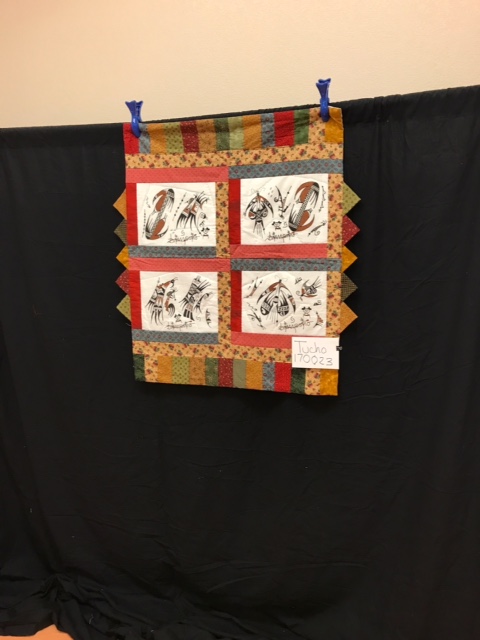
On the documentation side, the group documented two quilts, first, Kate’s Dahlia Wreath, a lovely hand quilted piece she found in a yard sale last summer.   Four salmon dahlias with red centers were connected by green leaves while the fifth dahlia proudly took center stage.  Terry shared the next one, Mimbres Symbols, a quilt she made after attending a workshop in 2003. This lovely four block quilt was bordered in stunning turquoise and black.  Details of this program are available on the AZQS web site www.azquiltstudygroup.org/.

Anyone is welcome to visit our meetings!  We love guests.  For questions about either quilt documentation or joining the team, please either call or email Tucson liaisons Sue Franklin, (520.490.4721; suevette63@comcast.net) or Terry Gryzb-Wysocki, (520.749.9326; terry-gw@mindspring.com).  New team members are welcome. Monthly training sessions are held from 9:30 until 12:30 at the Ellie Towne Flowing Wells Community Center on Ruthrauff Road.  The next meeting is Monday, June 11th. 

Information about quilt documentation teams throughout Arizona may be obtained from Lynn Miller at either 480.202-1230 or azquiltdoc@yahoo.com.  Lynn also needs people familiar with the computer to aid her with data entry for the Quilt Index.  Lynn does distance training which takes about two hours.


Friday, March 16, 2018

Sharlot Hall Museum, Prescott, Arizona


The Phoenix Metro documenting team does most of our Arizona Museums.  Recently we have begun documenting quilts at the Sharlot Hall Museum in Prescott, Arizona.  They have about 80 quilts in their collection.  We completed 20 on our first visit this week. Members of the Heritage Quilters gave us a hand folding and sorting the quilts.  Many hands make light work.  The Sharlot Hall Museum quilts will soon be seen on our Arizona page of the Quilt Index.

It was a great day, always fun and educational to see these quilts up close.  One quilt in the collection, from Sharlot Mabridth Hall, is this faded and worn red and green applique. Still a beautiful example.  The Heritage Quilters have reproduced this quilt for the museum and that quilt can be seen in the governor mansion at the museum.  

A member of the American Quilt Study Group is doing research on early quilts with borders of vases of flowers.  I have shared this interesting quilt for the research. This kind of connection and ongoing study, education and research is what makes all the time and effort of documenting our Arizona quilts worthwhile and very exciting.


Saturday, January 20, 2018

Emma Andres Quilts


Lynn Miller is sharing a multi-part post about Emma's work on her blog.  Click on the link below to read.  You don't want to miss this!


See a small exhibit of Emma's Quilts at the Arizona History Museum

     January 13, 2018 to February 28, 2018

Emma Andres Quilt Collection

949 E. 2nd Street
Tucson, AZ  85719
520-628-5774

Tuesday, January 2, 2018

Sue's News - December

Below is the information for the Gee’s Bend presentation that Bea Kabler did in December for the doc team.

Bea Kabler offered the continuing education segment.  Her topic: The Quilts of Gee’s Bend.  Bea grew up in Alabama and traveled in the area of the Gee’s Bend quilters many times over the years.  She noted that most of the makers were descendents of slaves from the Mark Pettway’s plantation in Alabama.  There is an area in Alabama known as the “black belt” where the preponderance of people is black.  While called Gee’s Bend in the past, the Post Office renamed it to Boykin in 1949; however, it remains Gee’s Bend to the locals.

The area is U shaped, 5 miles across and 7 miles long and on three sides, has the Alabama River.  In the early years, there was a ferry, but gone since the mid 1960s, making a very long trip on a bad road to get to town to register (to vote).  Bea noted Gee’s Bend inhabitants didn’t lose privileges because they were black, but because “they forgot they were black.”

Before 1932, a kind merchant extended credit to the folks of Gee’s Bend.  That changed dramatically when he died and his shrewish wife took over the store.  She collected with a vengeance!  In 1962, a dam to generate electricity was built and the outcome meant the most fertile acres were flooded.  Gee’s bend women began to have an interest in quilting and also to have some involvement with a bee in nearby Alberta.

Gee’s Bend quilters, from remote Gee’s Bend, ultimately became Cinderellas. They were stars on the contemporary art scene with vivid patterns made with fabrics from their every day clothes.  Shy, elegant, prolific, they delighted in the respect and appreciation that greeted their efforts.  Their goal:  to break the pattern: to see what others do and then change it, to make it their own.  Gee’s Bend quilters offered bold new approaches to a distinctive American art form. The quilts of Gee’s Bend introduced bright contrasting color and a dramatic contrast to traditional American and European quilting.


Monday, September 18, 2017

Sue's News - October

Arizona Quilt Documentation Project – Tucson
By Sue Franklin

In September, the team finished documenting team member, Bea Kabler’s Hopi quilts.  Other Hopi quilts documented belonged to team photographer, Peggy Hazard.  Bea also brought a change of pace for the team, her Mimbres Queen quilt.

Now, let’s review the quilts.  Bea’s quilts will be covered first. 
1)  A Mud Hen Katsinas, a lovely four block quilt with identical rust colored mud hens on white ground.  The blocks, framed in black, were hand painted by Bonnie Nampeyo Chapella, Corn Clan. 


 2) Hopi Pottery Blocks, hand painted by Bonnie Nampeyo.  Bonnie used her Great, Great Grandmother’s pottery blocks for the design for this four block quilt encased in shades of brown.


  3) Another Hopi Pottery four block, again hand painted.  This one separated by either salmon or gold print sashing or blue print and red or salmon sashing.  It has short saw tooth borders on sides; strips, picking up the colors of the sashing, on the quilt’s top and bottom.  


4)  Bea’s last Hopi Pottery block is rectangular with three hand painted blocks separated by sashings of green with pieced rectangles between.  Saw tooth borders on each side.  Warm brown shades predominate on this quilt.  


Bea brought another quilt that she hand pieced and then had hand quilted; her Mimbres Queen treasure.  This quilt, done in turquoise, black and cream is Bea’s daughter’s favorite.


Peggy’s first also is a Hopi 1) Long Hair Kachina Paintings with windmills in yellow, turquoise, purple, and bright pink. 


2) The next, a One Patch Hopi is made of corduroy with a flannel back.  The tied quilt is made from greens, blues, and browns and looking at it from a distance, one can imagine butterfly wings. 


3) Peggy’s last quilt, Hopi Scrappy Sampler, contains a wealth of vintage fabrics.  Red ties hold this gem together.

Details of this program are available on the AZQS web site www.azquiltstudygroup.org/.

Anyone is welcome to visit our meetings!  We love guests.  For questions about either quilt documentation or joining the team, please either call or email Tucson liaisons Sue Franklin, (520.490.4721; suevette63@comcast.net) or Terry Gryzb-Wysocki, (520.749.9326; terry-gw@mindspring.com).  New team members are welcome. Monthly training sessions are held from 9:30 until 12:30 at the Ellie Towne Flowing Wells Community Center on Ruthrauff Road.  The next meeting is Monday October 2ndAnother date to mark on your calendars is the Public Documentation on November 11th at the Arizona History MuseumContact either Sue or Kate Clark (520.742.1000) to register no more than two quilts.


Information about quilt documentation teams throughout Arizona may be obtained from Lynn Miller at either 480.202.1230 or azquiltdoc@yahoo.com.  Lynn also needs people familiar with the computer to aid her with data entry for the Quilt Index.  Lynn does distance training which takes about two hours.

Tuesday, September 12, 2017

New Quilt Display at Tempe History Museum

From Peggy Hazzard:

The Migrant Quilts will be on display at the Tempe History Museum from August 24 to September 21. Share the invitation with anyone who would be interested.


Sunday, September 10, 2017

Documentation Forms Updated!

From Lynn Miller:

The Arizona Quilt Documentation Project is going into it's 6th year documenting quilts in Arizona. You can see 2915 Arizona quilts on the Quilt Index. I find that amazing! It would not have been possible without all the volunteers that work so hard getting all the quilts documented. Many have been with us since the beginning.
I know you have been thinking you need to get your own quilts documented. Yes, you do. It is not hard. You can print out the forms right here on this group. Contact me anytime about getting photos of your quilts.
I have been working steadily getting my quilt collection documented. It sure is fun to see them on the Quilt Index.


Thursday, July 13, 2017

Sue's News

Arizona Quilt Documentation Project – Tucson
By Sue Franklin

In July, the group welcomed guest, Carolyn O’Bagy Davis.  After a brief business meeting, Carolyn presented the continuing education program on Hopi quilts and her journey of discovery.  Carolyn noted that her involvement was quite accidental.  She was invited to the mesas to see some excavations, went on to visit the Hopi Indians, and began to notice the quilts.  They covered ovens, roof tops, or were to sit upon, and babies were wrapped in quilts.  She thought they were made by “bahanas,” white women or missionaries, but they were not.  In historic times, men made the blankets and clothing, not the women, because only men sewed.  They spun and wove the cloth, made simple dresses, and red, green, and white woven belts to tie around the dresses.

In the 1890s, quilting was introduced to the Hopis by missionaries who lived with them.  Also, around that time, children were sent to boarding schools where girls learned homemaking skills including sewing and quilting, and boys acquired shop skills.  Eventually, the missionaries realized that teaching quilting was the most effective way to get the Hopis to attend church.  The women made quilts while the men stitched and tied thin mattresses.  Today there are fourth or fifth generations of Hopi quilters, women as well as some men.

Details of this program are available on the AZQS web site www.azquiltstudygroup.org/.

Hopi Quilts documented included the following:  1) Painted Tile, a blue ribbon quilt with corn in the husk borders and between some blocks, skilled painting by maker; 2) Hopi Pottery with Yellow and Purple (Prairie Points on two sides); 3) Painted Pottery;  4) Flat Doll, a cheerful flat doll surrounded by bright yellow sashing and red borders; turquoise ties; 5) Field Mouse Goes to War; Nine blocks surrounded by narrow black, with sashing and borders in cheery diamond print of blue yellow and orange, tells antics of Field Mouse as he goes to war. Black wool ties.  6) Morning Song Kachina; Nine lovely Kachinas surrounded by sashing and borders of pots and baskets.  Narrow tan binding.

Anyone is welcome to visit our meetings!  We love guests.  For questions about either quilt documentation or joining the team, please either call or email Tucson liaisons Sue Franklin, (520.490.4721; suevette63@comcast.net) or Terry Gryzb-Wysocki, (520.749.9326; terry-gw@mindspring.com).  New team members are welcome. Monthly training sessions are held from 9:30 until 12:30 at the Ellie Towne Flowing Wells Community Center on Ruthrauff Road.  The next meeting is Monday, July 10.


Information about quilt documentation teams throughout Arizona may be obtained from Lynn Miller at either 480.202.1230 or azquiltdoc@yahoo.com.  Lynn also needs people familiar with the computer to aid her with data entry for the Quilt Index.  Lynn does distance training which takes about two hours.

Tuesday, June 27, 2017

Baltimore Album Appliqué

Baltimore Album Appliqué
Susan T. Franklin, PhD
June 5th, 2017

Every experience deeply felt in life needs to be passed along.  Whether it be through words and music, chiseled in stone, painted with a brush, or sewn with a needle.  It is a way of reaching for immortality.  Thomas Jefferson.

I’m happy to share with you my passion for Baltimore Album appliqué.  First, about the quote I read by Thomas Jefferson.  I discovered this on a quilt block made by Marylou McDonald, a noted Baltimore Album authority and teacher.  I loved it and have since incorporated it for other presentations and someday, will on my work.  Meanwhile, consider a couple phrases, “sewn with a needle” and “way of reaching for mortality.”  Isn’t that what we’re about?
Today, we’ll learn more about quilts, sewn with a needle, made by mostly middle and upper-class women.  These quilts represented their best work; perhaps their masterpieces.  In some instances the quilt makers are noted; other times they are not.  Regardless, these beauties are a testament to the skill and lasting endurance of the talents of their makers.
Later, I’ll have reproduction examples of Baltimore appliqué wall hangings and a quilt.  Now, for the rest of the story!  To set the stage for this period, let’s briefly look at two broad categories:   technology and culture and how they intermingle.

1830…Block printing of fabric was rarely used; instead fabric was printed with an engraved copper cylinder, using a separate cylinder for each color.

1830-40 …A myriad of fabric choices was available.  New England textile mills produced millions of yards annually.

1830-40…Rapid railroad expansion meant more fabrics were quickly available to more distant places.

1840s…Baltimore was a prosperous port town, on the brink of full industrialization

1844…John Mercer introduced “mercerizing,” aimed at increasing the strength of cotton and aiding its ability to accept dye.

1844…Elias Howe invented the sewing machine.

1849…Walter Hunt invented safety pins.

1850…12 year old Margaret Knight had an idea for a device to “stop motion” of machinery in textile mills-thus preventing injury.  Incredibly, one of her inventions, a machine to make flat bottomed bags, still is in use today.

1850…Turkey red solidly is in use.

1851…Singer Sewing Machine Company is founded…time payments made machines affordable to anyone with a steady income;  sewing machines freed women from the tedious work of sewing and allowed time for handwork creativity.

1856…The discovery of aniline (aniline = indigo plant) dyes increased the range of colors available for weaving and printing of textiles (Kiracofe).

Productivity increased on the farm.
1831…Cyrus McCormick invented the reaping machine, able to cut 10 -12 acres, rather than one acre by hand.

1837…John Deere invented the steel plow.

Comfort also increased in the home
2nd quarter of the 19th century. 
·        Steam radiators, ice machines, new stoves, and lamps became available.
·        There was more delineation between the city and the country.
·        Quilt designs took longer to get to the country. 

Appliqué quilts and their story
Late 18th century and early 19th century
Medallion quilts were popular and done with chintz appliqué.  A dominant central design was framed by smaller appliquéd pieces.  The technique used was Broderie Perse (Persian Embroidery) and was done with chintz fabric imported from England until about 1840.  We discussed that in a previous continuing education program.

Mid-19th Century Appliqué quilts 
Robert Shaw refers to the period 1840 -1860 as the Golden Age of Appliqué.  Appliqué quilts increased in popularity in the 1840s per Elizabeth Warren, curator of the American Folk Art Museum in New York for four reasons:
1.     “Fashion” for album quilts…made with a variety of techniques… conventional, cut out chintz appliqué, piecing, or embroidery.  However, piecing is rare to find in an album quilt.
2.     Increased availability of relatively inexpensive fabric by mid-century; quilters found the fabric better for conventional appliqué than chintz.  Chintz prints had a limited number of repeats that could be used; thus not as useful for appliqué.  Also, quilters began to prefer blocks over medallions for their quilts.
3.     Adoption of quilt-making tradition of their English American neighbors by Pennsylvania Germans.  Previously, they slept under heavy home woven ticks filled with straw and feathers.  Circa 1830, quilters began incorporating German motifs such as rosettes, flowers in pots, birds, lilies, and tulips into their quilts.
4.      Red and green are popular in much Pennsylvania German folk art.  This enjoyment transferred into a traditional appliqué color choice

Fabrics used
Ombre’ prints, rainbow effects (fondue/fondu = to dissolve or melt) very popular during the period of 1830 – 1850, were used to create the illusion of dimension.  Also, all over prints (vermiculates), Turkey red prints or solids (pinks, chrome yellow and cheddar), and many novelty prints were available (Trestain, p. 44).  Wool and velvet were occasionally incorporated.  Both European and U.S. block and roller printed fabrics were used.  The makers employed wide selections of fabrics to create variety and dimension in their work (Kiracofe, p. 92).

Techniques
Just like quilters today, those of the mid-19th century employed a variety of techniques.  These include Broderie perse with cut out chintz appliqué, paper templates for appliqué, cross stitch, overcast embroidery, traditional and reverse appliqué, layered appliqué, ruching, cording, stuffed work (trupunto),interwoven strips, inking, outline embroidery with wool, and beading (steel beads).
Appliqué with white thread and sometimes thread to match pieces, was the norm.  The appliqué usually was done with invisible stitches, but sometimes blanket, buttonhole, chain, or other obvious stitches were used to attach the pieces to the background.
Cutwork, patterns made like paper snowflakes, also happened.  Do you remember making them or dancing dolls as a child? 

Popular Motifs
Wreaths, oak and laurel, oak reel, stylized floral designs, roses (one of the most popular), were frequent design elements.  I’ll have more examples when I discuss Baltimore Album quilts. Borders with either appliquéd swags or pieced works were common.

Quilting
The quilts were mostly hand quilted; machine quilting was very unusual.  However, a quilt, circa 1860, in the collection of the State Historical Society of Iowa is machine quilted.  Was it done later?  (The Quilt, p. 214)  We’ll never know.  We do know that when a woman had a sewing machine, she was proud to use it and show the stitches.

Quilting Designs 1840s – 1870s (Kinney p. 47)
·        Simple motifs, filler patterns of closely stitched diagonal parallel lines, cross hatch, or double or triple lines of quilting.
·        Alternate blocks… simple or ornate patterns, sometimes the outline of a Baltimore Album pattern.
·        Elaborate appliqué… hearts, flowers, prince or princess feathers with variations.
·        Desire to add symbolism, sentiment, superstition, and fill all spaces.
·        Inspiration from all sources especially nature, particularly with flowers.  Background grid added emphasis to botanical shapes.
·        Elaborate quilting in alternate blocks using combination of elements just mentioned.

General Information
The blocks were usually large, about 18” with the smallest being about 12.”  Some blocks were separated by sashing.  Some quilts had borders; others did not.  Some were fringed.  Most bed quilts didn’t have a cut out for a four poster.  This was a change from earlier periods.
Sampler quilts included non repeating blocks…Baltimore Album quilts were first identified by Dr. William Rush Dunton, early in the 20th century. 
Dr. Dunton was affiliated with a psychiatric hospital in Baltimore.  While looking for a craft project for his “nervous” ladies, he stumbled on some old quilts and subsequently Baltimore Album quilts and blocks.  In 1946, he published Old Quilts
A Baltimore Album quilt is defined as one made by someone living in Baltimore during the period 1846-1854 Its height of popularity was in 1850.  Robert Shaw notes that the best of these have long been considered to “represent a pinnacle of American quilt-making technique and design sophistication.” 
The designs were similar to those on other media of the 1840s such as theorem paintings, samplers, transfer printed ceramics and illustrations.  There also were similarities to earlier printed fabrics.  Also, Baltimore Album quilts contained specific pictorial images of urban Baltimore life…ships, churches, people, monuments, and military heroes that were presented in a rigid and segmented form (Baltimore Album Quilt Tradition, p. 16).
Many were made for Methodist ministers who were given new assignments every two years.  Also, some were made for other men, possibly those who served in the Mexican war or for other patriotic reasons.  It’s common to find names, dates, and other inscriptions on quilt blocks.  Inking was common.  Sashing usually was not used, although it’s present on some quilts.
Unfortunately, none of us have a Baltimore Album quilt, although at least two exist in Arizona (Grand Endeavors).  The best available today would be a reproduction.  Some of you may have seen an article in the American Quilter, January 2010, by Janet Esch and titled “Tracing History.”  In it, Janet describes how Marylou McDonald, Margo Cramer, and Eleanor Layman, without payment, spend hundreds of hours tracing these antique treasures housed in museums.  My reproduction examples are from quilts in the Lovely Lane Museum in Baltimore.
First, I have a quilt with the following blocks:  From the Elizabeth MacCullough Hervey quilt (circa 1848-52) Red Basket with Squared Bottoms, Blue Floral Urn, Overflowing Fruit Basket with Exotic Birds, Kind Lucy, a Frigate, and the Hunter.  My other completed examples are wall hangings.  One is a Cornucopia block from the Reverend Hezekiah Best quilt, circa 1846-1847.  The quilt was given to Reverend Best when he left the interdenominational Seman’s Bethel Mission.  He served as Chaplain from 1844-1847. 
The other is an Eagle from the Captain Russell quilt. Captain Russell was presented his quilt for excellent seamanship during a violent storm on the Chesapeake in 1852. These are examples of elaborate, high style design.  The Eagle block I finished in January, 2015.  Guess when it was started?  In 2007! 
A year ago, I completed a block from a newly discovered album quilt, The Gold Rush quilt.  Incredibly, I was attending a Baltimore Album workshop at Cactus Quilts when the original owner came to the shop with the quilt.  Marylou McDonald, Nancy Landon and the students were in awe; the owner was bored!  The quilt, now housed in Winterthur Museum, had the pattern carefully traced by Marylou and her team.  My block is “Oh Susanna, don’t you cry for me.”  I recently started a basket block from that quilt.  My goal is to make 4-6 blocks.
Another type of sampler quilt, but not a Baltimore Album quilt is an album quilt made by an individual or a group, not living in Baltimore, but living anywhere from the East coast to the Mississippi between 1840 -1860. The movement began in Pennsylvania and Maryland.   In an album quilt, the motifs in each block are different, but with enough in common that they work well stylistically.  Generally, a group album quilt would be coordinated by someone to ensure the blocks would complement each other.
These quilts are part of the sampler tradition as the block motifs usually don’t repeat.  The quilt style is a continuation of the autograph album so popular in the early part of the 19th century especially with the middle and upper-class.  Often, the quilts had a decorative outer border, usually a trailing vine or floral wreath, but occasionally pieced blocks were used.
One example of an album quilt includes the Bird of Paradise quilt top (housed in the American Folk Art Museum in New York).  The top, made in the mid-19th century, was found with newsprint and paper templates that dated from 1858-1863.  These included a bride and groom. The finished top omits a groom; instead leaves and vines are substituted on block two, next to the bride.  It’s theorized to be a wedding quilt due to the numerous indicators of fertility (fruit, pairs of birds, animals, eggs in a nest).  Perhaps the bridegroom to be was killed in the Civil War. 
This famous quilt, altered slightly, also is known as the Civil War Bride quilt (Australian version), the Lost Boy quilt (traced from the original Bird of Paradise top), and an adaptation by Karen Mowery published in A Bountiful Life.
My Civil War Bride reproduction includes a four block un-quilted wall hanging: The Apple Stem, Bride, Two Peacocks, and Peacock.  It will be hand quilted eventually.  I have one more block, but decided not to use it as I’d have to make a sixth to make it workJ

Closing
We’ve covered much this morning.  We noted the rapid technological and cultural changes of the first half of the 19th century.  Some enabled women, particularly from the middle and upper-class, to indulge in the creativity of handwork.  They made their best quilts; their masterpieces.
They appliquéd with a myriad of wonderful fabric choices, used an array of techniques, and created outstanding quilts.  These women very aptly demonstrated that “sewn with a needle” is indeed a way of “reaching for immortality.”
Thanks for your attention.  Now, what questions or comments do you have?

Monday, June 26, 2017

Sue's News

Arizona Quilt Documentation Project – Tucson
By Sue Franklin

In May, Tucson team member, Judy Breneman, presented a Brief History of Bed Rugs and Wool Appliqué. She noted that in the 1700s and early 1800s rugs or “ruggs” were made not for floors, but to decorate household tables and other furniture, eventually beds.  In 1810, the Oxford English Dictionary defined a floor rug as “a little rug for your hearth stone.”

Rugs were made by varied methods.  Some consisted of wool yarn sewn unto a firm ground in a looping manner while others were made with closely embroidered stitches that gave dimension without the looped style.  Often, embroidery was added for further embellishment.  By the middle of the 19th century, hooked rugs were popular in America.  Penny rugs also became fashionable at that time.  Details of this program are available on the AZQS web site www.azquiltstudygroup.org/.

Quilts documented included the following:  Sandy Woods Saguaro Harvest, a reproduction Goldie Tracy Richmond quilt.  This beauty was Sandy’s first needle turned quilt.  Peggy Hazard brought two quilts made by the second Guild President, Phyllis Kroggel.  Peggy now owns these lovely wall hangings.  One was a Pink Sampler and the other a Blue Sampler.  The final quilt belonged to Sue, Petite Dear Jane, a wall hanging.  She made this in the manner of the famous 1863 Jane Stickle quilt, but a much smaller version.

Anyone is welcome to visit our meetings!  We love guests.  For questions about either quilt documentation or joining the team, please either call or email Tucson liaisons Sue Franklin, (520.490.4721; suevette63@comcast.net) or Terry Gryzb-Wysocki, (520.749.9326; terry-gw@mindspring.com).  New team members are welcome. Monthly training sessions are held from 9:30 until 12:30 at the Ellie Towne Flowing Wells Community Center on Ruthrauff Road.  The next meeting is Monday, June 5th.


Information about quilt documentation teams throughout Arizona may be obtained from Lynn Miller at either 480.202.1230 or azquiltdoc@yahoo.com.  Lynn also needs people familiar with the computer to aid her with data entry for the Quilt Index.  Lynn does distance training which takes about two hours.